
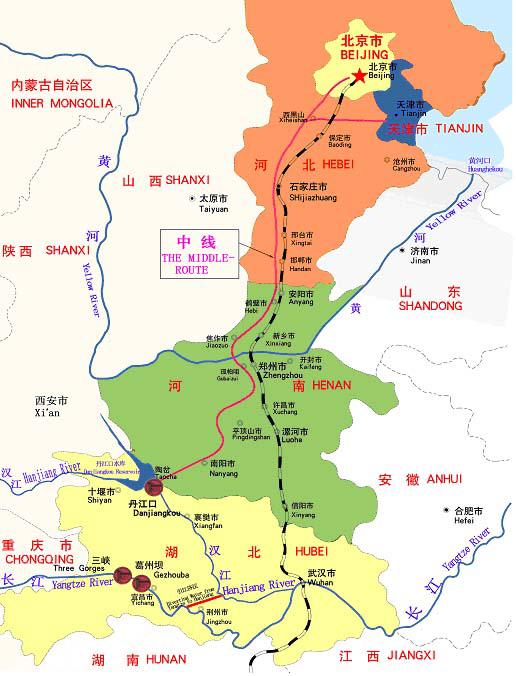

The shortage of freshwater jeopardises China’s rapid development, in particular in North China. To tackle the challenges, the Chinese government built a $62 billion South-North Water Transfer Project (Eastern, Middle, and Western routes), and diverts 44.8 billion cubic meters of water per year from the Yangtze River in southern China to the Yellow River Basin in the arid northern China. The Middle Route Project (MRP) for South-to-North Water Transfer diverts water from Danjiangkou Reservoir on the Han River, a tributary of the Changjiang River, to Beijing City through canals. The MRP aimed to mitigate the crisis of water resources in Beijing, Tianjin, and North China Plain, and increase the irrigated area by 0.6 million ha, 6.4 billion m3 for municipal and industrial water supply, 3.0 billion m3 for agriculture for Beijing, Tianjin, Hebei and Henan provinces. It also worked to significantly improve the biological environment and investment environment of receiving areas, and boost the economic development in China. However, there was increasing pressure on the safeguards in both the quality and quantity of the water sources of the South-to-North Water Transfer.
The government of China formulated a national legal framework for watershed eco-compensation, international payment for environmental services, which was intended to clarify the property rights of stakeholders, particularly the upstream and downstream in river basins. Green Water Management & Credit for China (GWM&C) was supposed to be tailored and implemented, working closely with Chinese partners, in the Danjiangkou Reservoir catchment, a representative part of the Yangtze River Basin in China. GWM&C allows quantification of erosion reduction, yield increase, sedimentation amounts, water availability, and electricity production that is needed to calculate the economic costs and benefits of environmental protection measures. This information allows the development of a financial mechanism in , for example, river catchment area’s based on upstream supply and downstream demand of water services for long-term investments in communities.
The Danjiangkou Reservoir, situated in the Danjiangkou City, Hubei province (see map above), was the water source for the Middle Route Project (MRP) for South-to-North Water Transfer, which diverts water from Danjiangkou Reservoir on the Hanjiang River, a tributary of the Changjiang River to Beijing City through canals along Funiu and Taihang Mountains.
ISRIC coordinated for the project and worked closely with a Dutch consortium (FutureWater and Nelen & Schuumans) and Chinese partners.